Why Innovation and Compliance Now Depend on the Right Partners

Tech Sourcing in Healthcare


Innovation and speed have become decisive success factors in healthcare and life sciences. Pharma and medtech companies must accelerate R&D and clinical timelines while meeting strict regulatory requirements. To succeed, they face two imperatives: freeing up budget for innovation and partnering with the right technology providers to deliver speed, compliance and resilience at scale. A well-designed tech sourcing strategy is one of the few levers that enables both.

In this environment, technology has moved from a supporting role to a central driver of performance. It now directly determines R&D productivity, clinical efficiency and regulatory robustness. Technology decisions increasingly determine time-to-study, time-to-market and audit readiness.

As a result, tech sourcing in healthcare has moved beyond negotiating better rates. It has become a strategic lever shaping the partner ecosystem that drives both innovation speed and compliant scale.

Sourcing decisions therefore increasingly define whether investments translate into measurable outcomes or remain fragmented initiatives without impact.

Typical examples include cloud platforms for compute-intensive simulations in early drug discovery, AI-based analytics for real-world data, clinical trial management systems, regulated data and cloud platforms, or validated manufacturing and quality systems such as LIMS, MES or RIMS. Building these capabilities in-house is often too slow and too costly. Recent healthcare programs illustrate the scale of this challenge: across global pharmaceutical and medtech companies, technology-related spend exceeds €2 billion per year, with managed services, cloud platforms and data capabilities among the fastest-growing components.


When Innovation accelerates faster than Regulation

Healthcare’s regulatory environment makes this challenge particularly acute. Validation requirements, auditability and patient safety impose strict constraints on speed and flexibility. There are few industries where the connection between technology decisions, regulatory responsibility and economic performance is as direct as in healthcare. Every sourcing decision therefore carries implications not only for cost and capability, but also for continuity and reputation.

Innovation must accelerate – yet control cannot be loosened. Tech sourcing therefore operates under constant tension between speed and regulatory certainty. It becomes the connective element between innovation ambition, operational stability and long-term competitiveness.


Why Healthcare Tech Sourcing follows different Rules

These constraints fundamentally change how sourcing decisions are made. Technology sits at the core of value creation and organizations depend heavily on specialized providers. Many partnerships are longterm by necessity, shaped by validation requirements, embedded platforms and high switching costs.

Price and performance alone no longer determine the right choice. Validation effort, documentation quality and audit readiness increasingly define total cost of ownership. Suppliers that integrate regulatory requirements into their delivery models often create structural advantages — even when their commercial offers appear less attractive at first glance.

In practice, fragmented supplier landscapes drive revalidation effort, slow down change cycles and dilute accountability during audits. Reducing interfaces and clarifying responsibility therefore becomes as important as reducing rates.


In healthcare, tech sourcing has become a strategic instrument that determines how fast innovation can progress, and how reliably compliance can be ensured as it scales.


Building the Cost Foundation

Effective tech sourcing in healthcare must start with a strong cost foundation. In an environment shaped by regulatory requirements and rising technology complexity, disciplined cost management remains essential. Three types of levers form the backbone of cost efficiency.

  •  

    Commercial Levers

    such as strategic negotiations, competitive RFx processes and optimized contract models

  •  

    Demand Levers

    such as service right-sizing, demand transparency

  •  

    Technical Levers

    including standardization, automation, AI-enabled service delivery, etc.

For a detailed discussion of levers across IT services, software, cloud, hardware and connectivity, see the Tech Sourcing at a Turning Point: The New Engine of Business Value article.. In healthcare, IT services typically account for close to 50 percent of total IT spend, making this category one of the largest and fastest value pools. Market dynamics are highly competitive, and the systematic application of these levers offers tangible savings potential of 15–25 percent – provided they are implemented in line with regulatory and quality requirements.

Leading organizations move beyond generic negotiation approaches and adopt differentiated, supplier-specific strategies. Instead of applying uniform levers across vendors, they use tailored negotiation playbooks that reflect each provider’s role in value creation, compliance exposure and strategic relevance.

Recent healthcare programs confirm the impact: structured negotiations and RFx initiatives in IT services have delivered sustainable cost reductions while increasing transparency and
sourcing maturity – creating the financial baseline for the next stage of tech sourcing.


How to create Value beyond Costs

With a solid cost foundation in place, healthcare organizations increasingly use tech sourcing to create value that goes far beyond savings. Cost efficiency enables investment in capabilities that directly support innovation speed, regulatory certainty and operational resilience.

In healthcare, critical outcomes cannot be achieved through cost levers alone. Tech sourcing therefore evolves from a commercial discipline to a strategic enabler. It determines access to scarce capabilities and clarifies accountability for validation, quality and operational stability across the ecosystem.

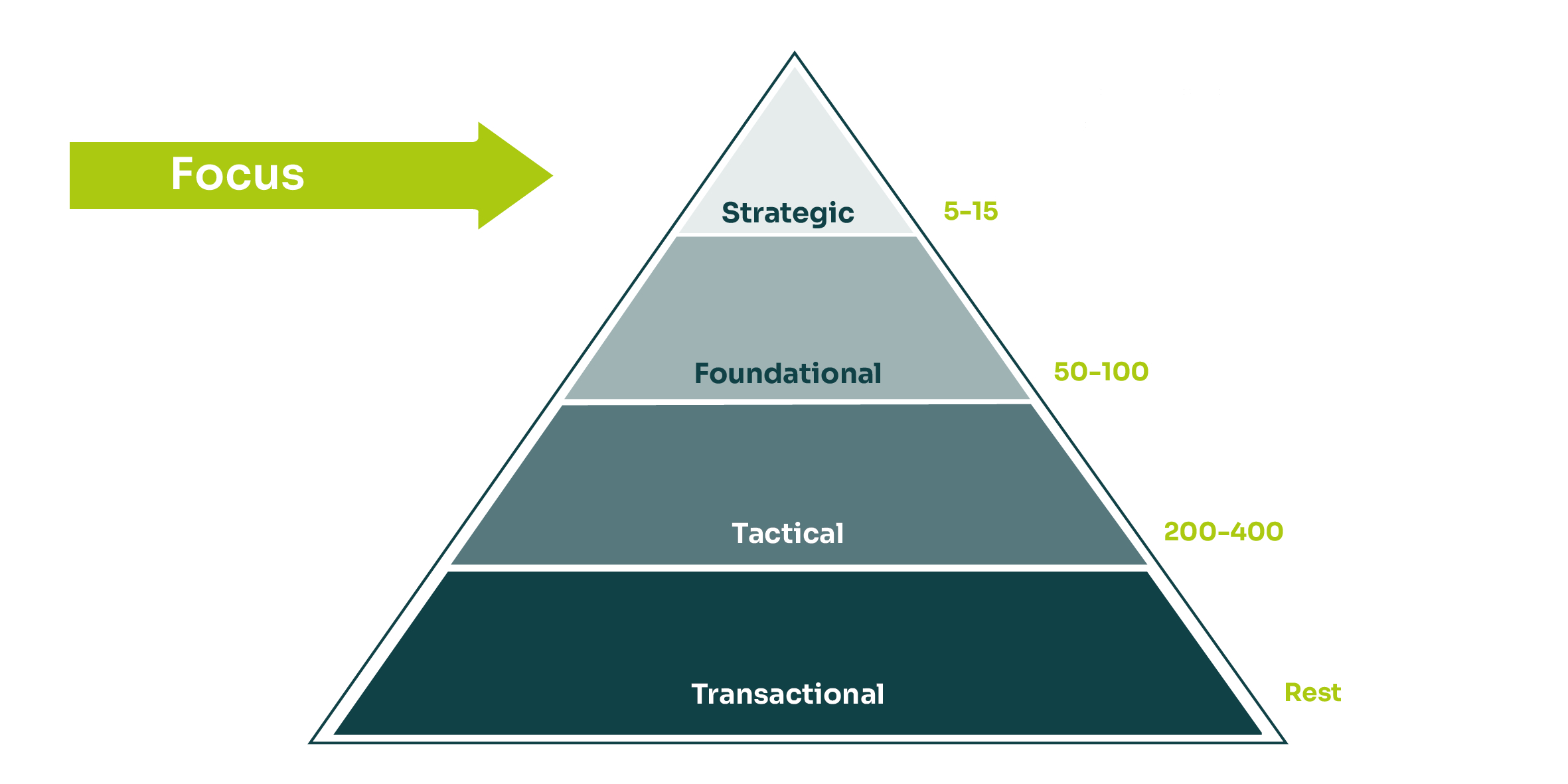
Not all tech partners create equal business impact. Leading organizations deliberately concentrate investment and governance on the few that drive differentiation and scale.

Strategic Partnerships as the Execution Model

As healthcare organizations shift from cost efficiency to value creation, strategic partnerships move to the center of tech sourcing. Rather than managing a broad supplier base, leading organizations deliberately concentrate on five to 15 partners with deep healthcare expertise, strong compliance capabilities and long-term commitment.

These partnerships typically span critical domains such as clinical trial platforms, CRM and commercial systems (e.g., Veeva), regulated data and cloud platforms, GxP validation, and advanced data, analytics and AI capabilities across R&D, manufacturing and commercial functions. What distinguishes strategic partners is not only technical expertise, but their ability to operate reliably within regulated processes and to scale innovation without increasing compliance risk.

Well-structured tech sourcing enables access to scarce capabilities while maintaining flexibility. It allows scaling during peak phases – such as late-stage clinical trials – and supports parallel execution across multiple partners.

To unlock this value, organizations increasingly move away from traditional, price-led tenders and adopt request-forsolution approaches. In co-creation with two to three selected partners, solutions are developed by jointly defining commercial models, technical architecture and accountability from the outset.

End-to-end Accountability as the Operating Model

End-to-end accountability is often discussed as an efficiency lever. In healthcare, it has a far broader strategic role. Technology landscapes typically span IT, Quality, Regulatory Affairs, R&D and external partners. When accountability is fragmented across interfaces, complexity increases and risks accumulate. Ownership becomes unclear during audits, validation activities are duplicated and innovation initiatives slow down.

A consistent end-to-end model consolidates responsibility for delivery, change and regulatory stability. It reduces coordination effort and creates clarity, particularly when responding to regulatory findings or system changes.

In large healthcare environments, shifting from horizontal towers to vertically accountable, end-to-end service models has proven decisive. Beyond cost synergies, it strengthens audit ownership, reduces validation rework and supports scalable automation.

A global biopharma organization with over USD 200 million annual IT services spend faced not only cost pressure, but increasing re-validation effort, unclear audit ownership and slow adoption of automation across R&D and commercial functions.

In addition to optimizing large IT service towers, the program also addressed healthcare-specific application landscapes, including the sourcing of a new CRM solution.

While commercial renegotiations and a global RFP delivered material savings, the decisive impact came from redesigning the sourcing setup toward end-to-end accountability and a value-focused partnership model. Consolidating responsibility reduced validation duplication, clarified regulatory ownership and enabled automation and AI use cases to scale without increasing compliance risk. AI agents were introduced to optimize vendor interactions and operational processes across R&D, manufacturing and commercial functions, reducing manual coordination effort, accelerating throughput and improving transparency. In total, the program unlocked more than USD 60 million in sustainable annual impact.


What this means for Executive Leadership

Tech sourcing in healthcare is no longer a transactional discipline. It is about shaping stable, scalable ecosystems that connect innovation ambition with regulatory certainty and economic resilience.

Procurement increasingly acts as a value orchestrator – integrating IT, Quality and business stakeholders, enabling fact-based decision-making and ensuring that sourcing models support both compliance and innovation.

Authors


Further Articles of this Issue