Procurement does not source parts anymore – it shapes technology architectural decisions and sources platforms.
Automotive Tech Sourcing: Securing Today, Shaping Tomorrow
Tech Sourcing in Industrial Goods


Tech Sourcing in Industrial Goods
The automotive industry is undergoing a transformation unlike any in its history. While volatility in materials, supply chains and trade measures continues to shape daily decisions, technology is quietly redefining the nature of the vehicle.
Software-driven functionality, digital capabilities and fast-evolving electronics now influence buying decisions as strongly as classical performance measures. Procurement sits at the centre of this shift, stabilizing today’s economics while enabling tomorrow’s digital product architecture.
Procurement teams in automotive face a dual mandate. They must maintain resilience in semiconductors, highvoltage systems and electronics – categories where instability continues to pressure margins – while supporting a product landscape increasingly defined by connectivity, UX performance and digital-ecosystem integration.
Trade measures remain structurally relevant. Nearly half of STOXX Europe 600 companies expect tariffs to influence their business, though only around one percent anticipate significant financial impact.¹
Automotive players remain more exposed due to globally distributed footprints and cross-border component flows. Protecting profitability while preparing for a fundamentally different technological future has become a continuous balancing act.
These pressures also explain why procurement’s focus is increasingly shifting beyond traditional components. As vehicles become more software-driven, sourcing decisions made for semiconductors, electronics and platforms directly shape the feasibility, cost and scalability of future digital functionality.
1 Inverto/BCG European Tariff Sentiment Research
Connected-vehicle parc will continue to increase
// Share of car parc w/ Internet access
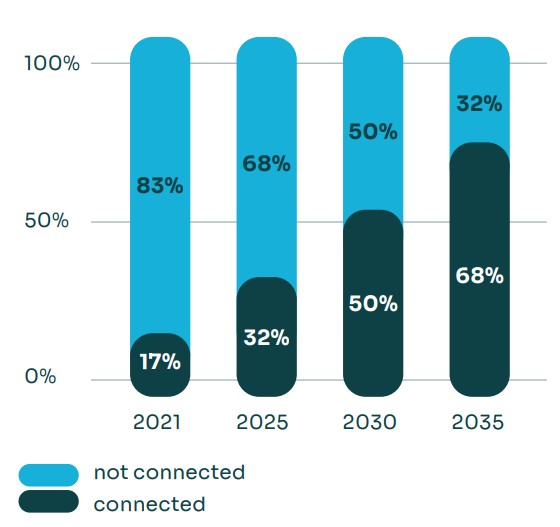
Source: As auto software revs up, suppliers need to switch gears, Nov 2024, BCG Analysis
Our cover story outlines how technology sourcing has become a strategic accelerator. Few industries illustrate this more clearly than automotive, where each new vehicle generation integrates more computer power, deeper connectivity, and expanding software-defined functions. These elements evolve rapidly, behave like consumertechnology ecosystems and require unified decision-making across engineering, IT, procurement and suppliers.
Procurement’s role is expanding accordingly. Instead of sourcing isolated parts, teams increasingly shape modular technology platforms and the interactions between digital building blocks. Earlier involvement in architectural decisions and a deeper understanding of technology ecosystems are becoming essential.
Procurement does not source parts anymore – it shapes technology architectural decisions and sources platforms.
Software now plays a defining role in customer preference. User experience, infotainment quality, seamless connectivity, and Over-the-Air (OTA) capabilities increasingly shape perceived value as much as driving performance.
Recent infotainment system developments underline this shift clearly. Industry experience and forward-looking projections point to a sharp increase in overall infotainment spend – accompanied by a steadily rising share of software content. What was once a supporting feature has become a core element of the vehicle value proposition.
As software content expands, so do customer expectations. Younger buyers in particular place greater emphasis on connectivity, infotainment performance and software-enabled features when choosing a vehicle.
This development aligns with BCG’s projection that software and electronics will form one of the most significant automotive value pools by 2030. BCG’s 2025 global automotive consumer study further reinforces this trajectory, showing that software-enabled functionality is increasingly expected as standard.
Software is no longer a technical layer; it is a commercial differentiator shaping brand loyalty and customer expectations from day one.
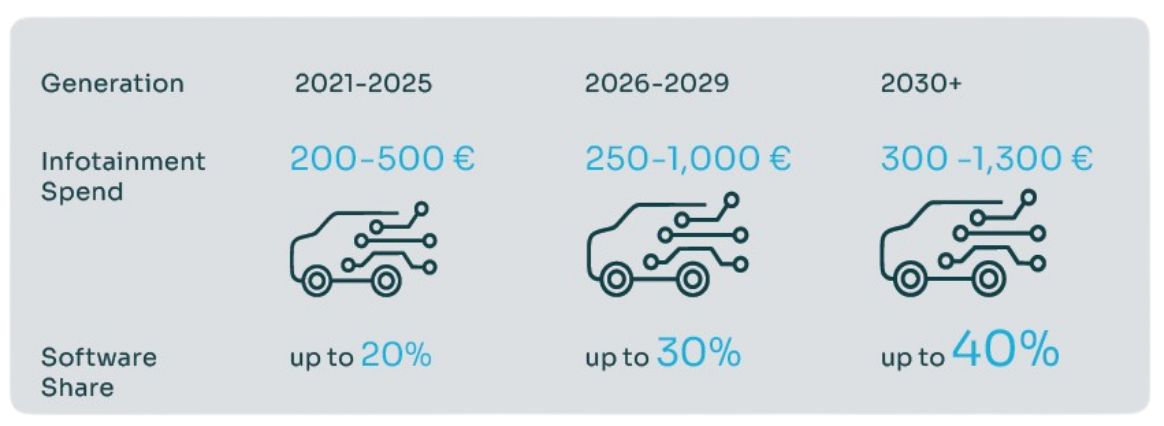
Indicative ranges based on industry experience and forward-looking projections. Figures reflect typical infotainment system spend and software share across vehicle generations. Actual values vary by OEM segment (volume vs. premium) and vehicle configuration (entry-level to fully equipped), but consistently illustrate the direction and magnitude of the shift toward software-intensive architectures.
Leading organizations clarify early which parts of the software stack they must control to maintain differentiation, and which can be licensed or codeveloped. This alignment between architecture and sourcing strategy preserves flexibility and reduces lock-in.
Traditional BOM (Bill of Materials) logic cannot capture software economics. Procurement teams build transparency by breaking digital features into functional components and assessing required engineering effort, enabling fact-based negotiations and long-term cost clarity.
Software negotiations hinge on lifecycle obligations. Update cadence, regional licensing, support models, cybersecurity responsibilities,
data ownership, and transition mechanisms all shape total cost and dependency. Procurement teams that succeed in this space adopt
negotiation frameworks tailored to software, ensuring clarity not only on development fees but on the long-term commercial implications of digital features that continue evolving long after start of production.
With OS providers, cloud platforms, infotainment partners and ADAS developers shaping the digital experience, procurement now orchestrates a complex ecosystem. Rather than managing suppliers independently, leaders define integration boundaries, interface ownership, and competitive dynamics that maintain flexibility and encourage innovation while reducing dependency risks.
This shift is also reflected in how OEMs engage with technology partners. Increasingly, manufacturers are moving beyond classical
supplier relationships toward deeper codevelopment models with Big Tech players. In some cases including shared roadmaps, joint
integration teams and new commercial constructs such as profit- or value-sharing mechanisms. These partnerships fundamentally change SRM requirements, governance models and risk profiles, elevating procurement’s role in structuring longterm collaboration.
High-performing organizations embed procurement early in architectural and makeor-buy decisions. Unified governance across engineering, IT and procurement ensures that sourcing supports long-term platform strategy.
Across regions and segments, different patterns are emerging. Premium OEMs often seek greater control over software layers that define brand experience, while volume manufacturers prioritize standardization and scalable partnerships. Asian players tend to integrate software and hardware development more tightly, while US OEMs frequently engage earlier with Big Tech ecosystems. These differences reinforce the need for procurement strategies tailored to product positioning and regional context.


Jan Marwedel
Senior Project Manager
Munich

Jennifer Herman
Project Manager
London