
From supervised pilots to supervised production
// Preview
Agentic AI in financial services refers to systems that can interpret context, propose actions, and execute decisions within predefined limits. In banks and insurers, this means portfolio agents proposing trades for approval, claims agents validating data and escalating low-confidence cases, and back-office optimization agents adjusting workflows under supervision.
The technology is in production at most major European institutions, but only in bounded forms. Scaling further runs into a different obstacle: the procurement and governance architecture surrounding it. Under the EU AI Act, DORA, BaFin circulars, and ECB guidance, AI governance is a board-level obligation, and supplier relationships sit within supervisory scope.
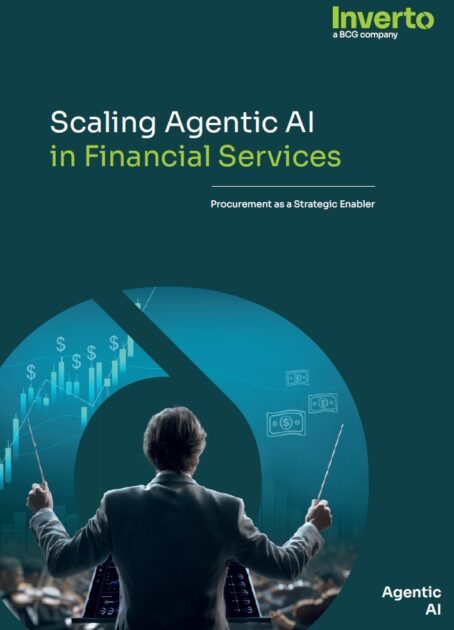
This white paper sets out how procurement leaders can build sourcing models, contract structures, and governance mechanisms that allow agentic AI to move from supervised pilots into supervised production.

What you’ll find inside the white paper
Grounded in financial-sector experience, the paper offers a practical roadmap for procurement, technology, risk, and compliance leaders preparing to deploy agentic AI under European supervisory frameworks.
- The delivery gap: Why procurement processes built for stable software cannot keep pace with systems that change between releases.
- A risk-tiered sourcing approach: How to match sourcing posture, contract structure, and governance intensity to front-, middle-, and back-office use cases.
- A three-phase procurement model: Governed PoC, MVP, Scale: how to align funding gates with verified outcomes and supervisory expectations.
- The components of an AI-ready contract: Responsibility mapping, audit rights, data control, conduct safeguards, and continuity provisions under the EU AI Act and DORA.
- Designing the supplier ecosystem: How to combine strategic anchors with niche innovators while keeping accountability and audit access in one place.
Where does the largest near-term value sit?
The near-term opportunity is concentrated in services banks and insurers have already outsourced. IT infrastructure, contact centers, and back-office processing together account for a significant share of external spend.
According to the BCG and OpenAI article How Retail Banks Can Put AI Agents to Work (2026), institutions that shift from task-level automation to agent-based workflows could achieve:
- Cost reductions of 30–40% by 2030
- Profitability gains of up to 30% by 2030
But existing supplier relationships were not built to absorb autonomy. Most contracts pre-date agentic AI and cannot accommodate it without redesign.
This is where procurement becomes decisive. It does not own AI governance, but it owns the layer through which autonomy is sourced and held accountable. Its role is to translate the requirements set by model risk, compliance, and operational risk into supplier and commercial constraints. For each use case, that means determining how authority is sourced:
- Build – when control and knowledge retention matter most
- Partner – when speed and differentiation require shared accountability
- Buy – when reliability and regulatory readiness outweigh customization
The white paper maps where the value is concentrated by service category, and what procurement needs to put in place contractually before suppliers can deploy agentic capabilities safely inside those services.
Fill out the contact form below to receive the complete white paper by email.
Download the full white paper
Get in Touch

José Carande Morgado
Managing Director
Madrid

Sven Brüggeboes
Managing Director
Cologne

Gustav Scheffler
Principal
Munich
Gain deeper Insights