What matters is not only how quickly transparency can be achieved, but how effectively it can be translated into decisions and measurable savings impact.

From fragmented spend to measurable impact
AI in Procurement: From Data to Value

AI in Procurement: From Data to Value
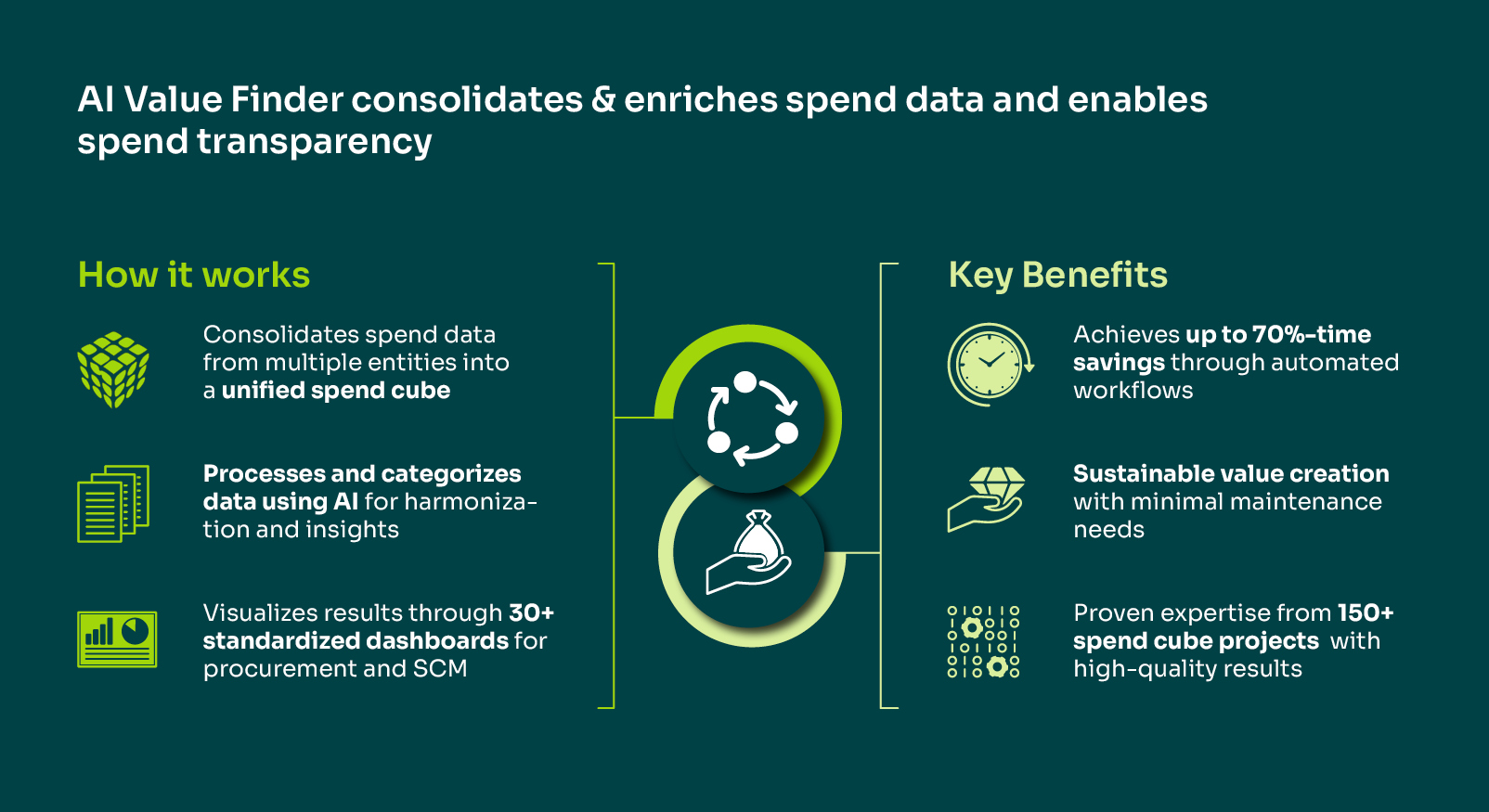
Procurement organizations often struggle to translate fragmented spend data into actionable savings opportunities. AI Value Finder leverages GenAI to create rapid spend transparency, uncover cross-entity synergies, and accelerate the path from data to measurable impact:
Most organizations don’t struggle to identify procurement levers. The real challenge lies in understanding where those levers actually matter, and doing so fast enough to act.
In practice, spend data is rarely structured in a way that supports this. It is scattered across multiple ERP systems, business units, and entities. Supplier names differ slightly from one system to another, category structures are inconsistent, and invoice descriptions often lack the detail required for meaningful analysis. In multi-entity environments, this complexity increases exponentially.
As a result, procurement teams often struggle to build a sufficiently reliable and comprehensive view of spend to identify and substantiate savings opportunities. Significant effort is spent consolidating, reconciling, and validating data across multiple ERP systems and entities, with inconsistent supplier naming, category structures, and transaction detail limiting confidence in the analysis.
This is where GenAI-enabled spend transparency changes the dynamic. By rapidly consolidating data and making supplier overlap visible across entities, it becomes possible to move beyond fragmented views and focus directly on identifying where scale, standardization, and price differences translate into real impact.
The question shifts from “How do we structure the data?” to “Where is the measurable impact?”
Creating transparency is often seen as the objective. In reality, it is only the starting point. What matters is not only how quickly transparency can be achieved, but how effectively it can be translated into decisions and measurable savings impact. AI Value Finder turns heterogeneous invoice and purchase order data into a single, structured fact base, without requiring perfect inputs. The result is a consistent and decision-ready view across entities, suppliers, and categories, accessible through intuitive dashboards that allow users to move seamlessly from high-level overviews to transaction-level detail.
This enables a different kind of conversation. Instead of debating data quality, leadership can focus on prioritization and action – grounded in a shared, evidence-based view. Importantly, the resulting solution is fully transferable to the client organization: transparent, adaptable, and designed to become part of the client’s own procurement ecosystem rather than a proprietary black-box tool.
A critical step in this shift is making cross-entity synergies tangible. While overlap between suppliers is often assumed, it is rarely quantified. AI Value Finder makes this visible and actionable by highlighting where suppliers operate across entities and where consolidation can create impact. In practice, this enables:
Rather than running fragmented local initiatives, organizations can focus on the few cross-entity levers that drive disproportionate impact.
What matters is not only how quickly transparency can be achieved, but how effectively it can be translated into decisions and measurable savings impact.
One of the biggest misconceptions in spend analytics is that clean, granular data is a prerequisite for meaningful analysis. In reality, most organizations operate far from this ideal, and waiting for perfect data is rarely an option.
Modern AI-enabled analytics approaches address data quality challenges as part of the analytical process itself: cleaning, harmonizing, and categorizing data within the analytics layer rather than as a separate prerequisite. In this way, data quality improvement and advanced analytics evolve together, turning what was traditionally seen as a barrier into part of the solution.
AI Value Finder takes this pragmatic approach. Using GenAI, it structures spend even when invoice descriptions are limited, relying where necessary on supplier-level intelligence to build a usable category view. The objective is not theoretical precision, but practical transparency – robust enough to identify value pools and move forward with confidence.
At the same time, speed becomes a critical factor. In rapid diagnostics, or early transformation stages, the ability to iterate quickly often determines success. AI Value Finder reduces analysis latency significantly:
In this context, speed is not just operational efficiency, it is a direct contributor to impact.
The objective is not theoretical precision, but practical transparency – robust enough to identify value pools and move forward with confidence.
At its core, AI Value Finder builds a consolidated spend model across entities, standardizing the key fields required for analysis – such as supplier, spend, entity, date, and account structure.
The impact of this approach becomes particularly visible in complex, multi-entity environments.
A Middle Eastern sovereign investment institution, overseeing a diverse portfolio across more than six industries, faced increasing cost pressure as many of its portfolio companies transitioned to operational maturity. With several entities still cash-negative and facing significant capex exposure, the need for a credible, portfolio-wide impact view was urgent.
By consolidating invoice and purchase order data across more than 15 portfolio companies, AI Value Finder created a comprehensive spend baseline. Around EUR 6–7 billion in spend was analyzed, with extrapolation indicating a total indirect spend baseline of EUR 8–10 billion.
Despite inconsistent data quality, GenAI-driven supplier harmonization and categorization enabled a clear view of spend structures and supplier overlap. What had previously been assumed became measurable.
This translated into tangible results:
What made this outcome compelling was not only the scale, but the credibility.
Clear spend concentration, visible price dispersion, and a focused initiative set enabled fast, low-disruption execution.

AI Value Finder is particularly relevant wherever fragmented spend data limits visibility and slows decision-making, whether in single organizations with complex structures or across multi-entity portfolios. It is equally valuable in environments where underlying data foundations are evolving, such as during ERP migrations, system harmonization programs, or broader digital transformations.
Its impact is strongest where time-to-transparency is the key constraint:
It is equally valuable in programs where capturing synergies requires a fact-based view rather than assumptions.

Christoph Schenter
Principal Digital & AI
Vienna

Simon Seggedi
Senior Manager Digital & AI
Cologne

Hussein Hanouf
Senior Consultant Data & Insights
Cologne

Nils Lehmann
Senior Consultant
Copenhagen