
// SMI 17 | Actively drive Sustainable Procurement
Thomas Udesen is CPO at Bayer. In this interview, he talks to us about changes in procurement, how a Life Science company with core competencies in the areas of healthcare and agriculture can become sustainable, and why he is actually teaming up with the competition to make this happen.
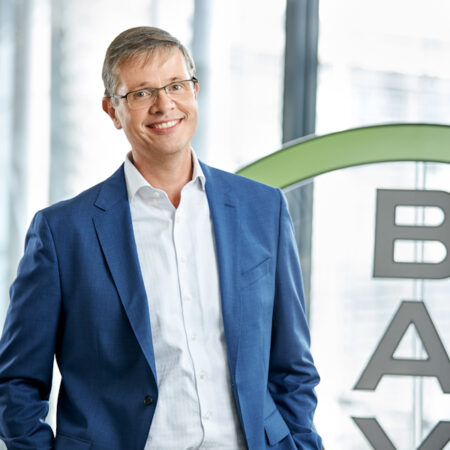
Thomas Udesen
CPO, Bayer
“If you want to go far, go together”
Mr. Udesen, if you look at the current situation when it comes to sustainability in business, what stands out to you?
There are two very different groups in business, with entirely different views on the importance of sustainable procurement. The first refuses to face up to the issue, consistently taking a defensive approach, with sustainability only a secondary consideration. They delay implementing regulations or measures as much as possible and exert, at most, the minimum of effort – and usually only to avoid getting into trouble. These companies aren’t focused on long-term planning and a better future, but on short-term financial interest. They leave the big issues such as climate change or inequality to other people – and to the next generation.
And how would you characterize the second group?
These are the businesses that have understood how important the issue is, and how important it will remain. They’ve grasped that it will play a deciding part in whether they can continue to be successful in the future. They’ve also recognized that sustainable procurement is by far the most significant lever to improve products, drive innovation or even safeguard human rights.
And which side of the fence are you on?
Here at Bayer, we are definitely in the second group. It’s embedded so deeply in our DNA that sustainability targets even help determine our bonus payments, which no longer depend solely on financial results. We were also one of the first companies to sign up to the UN Global Compact, and we encourage our suppliers to do the same.
How do you achieve that?
We always follow a similar approach: “Engage, Act and Disclose.” Engaging means putting the issue on your agenda and strategy and asking yourself questions such as “what is the human rights situation in our supply chain?” Then it’s a matter of acting: putting it into practice by providing sufficient resources for it and ensuring it’s monitored accordingly. Then the last step is disclosure; for example, in annual reports.

“Together” is the key word. You’re also responsible for creating the Sustainable Procurement Pledge (SPP) Initiative. How did that come about?
At TFS, we noticed how well cooperation works, how important close collaboration is and what an effect it can have. This led to the idea for SPP in 2019. Together with Bertrand Conqueret, CPO of Henkel I co-founded SPP. It is a registered and independent non-profit (gGmbH) organization with own funders. We are lucky that Bayer has also decided to become a “Champion” and provides funding. Back then, climate strikes were happening everywhere and the question came to me – how can it be that humans, who have achieved so much, are now in the process of destroying the planet? It’s a scenario that we’d all like to prevent. And the great thing is that in procurement, we have enormous clout when it comes to this. There are a million people working in this area alone; a million people spending more than ten trillion euros every year and who have access to virtually every market. So the idea is that if we join forces, we can actually transform every supply chain so the Sustainable Development Goals (SDGs) can be met by 2030. So far, we are well on our way and we’ve found 10,000 ambassadors from 145 countries.
What do you want the project’s focus to be?
We want to create and freely share knowledge. So far, we’ve been a voluntary community, which is now being funded with an executive management team. Next we’ll develop a digital platform that we’ll use to share knowledge on often very specific issues relating to sustainability and sustainable procurement. In the long term, we want people in our field to say “let’s SPP it” instead of “let’s Google it”.
Regulators are also pressing ahead, not just businesses. The EU wants to ban certain chemical products. What do you think about that?
I think it’s mostly helpful. Improving the legal framework benefits us as a company; not least because we’re already well ahead of many of the regulations. It’s important that we base regulations on scientific facts and not on emotions. I see this as a great opportunity for us to get better, more sustainable products that help us progress as a society. Procurement will also play a key role in this.
You’ve been working in procurement for many years. What are the biggest changes you have seen?
There have been four major changes. First of all, procurement has taken on a central coordination role, internally as well as externally. It has become increasingly credible in recent years and is now much more strategic than it was just a few years ago. The third change is the arrival of competence profiles: we’ve been joined by plenty of staff who didn’t start out in procurement, and their varied experience has made us stronger. The fourth big change is the implementation of new technology that makes it possible for us to do things more easily and efficiently.
Is this change helpful with sustainable transformation?
Definitely. Start-ups have managed to develop entirely new technologies and a heterogeneous tech landscape that’s changing traditional views and giving us entirely new perspectives. When it comes to transparency and risk analysis, new tools have come along that have a far bigger impact in companies beyond just procurement. That’s why I have to agree that of course technology has helped us. But ultimately it can’t bring about transformation on its own. We need people for that – and ideally every single one of us. Bayer has been around for over 150 years, and I want us to be successful for another 150 years and beyond.
Thank you very much for talking to us.
Further Articles of this Issue