It is important to set interim targets: milestones that need to be achieved in two, four or ten years.


// SMI 17 | Actively drive Sustainable Procurement
Due to the many crises we are currently facing, there is a risk that companies will neglect the issue of sustainability as securing supply and controlling costs could take precedence. However, it is precisely now that we need to finally tackle this transformation. There is a general consensus that we all have no alternative to taking action, but there is still a great deal of discussion about how, and also about why companies should lead the way when it comes to sustainability – and why procurement is an indispensable factor in this process.
It’s now 34 years since James E. Hansen, Director of the Goddard Institute for Space Studies sat in front of the Energy Committee at the US Congress and explained how he was 99 % sure that previously observed record temperatures were not the result of natural fluctuations. Instead, he believed man-made climate change was to blame, which in return meant that if nothing were to change, humankind was heading for a disaster. Obviously a lot has happened since then, but the scientific community agrees that humankind is still not doing enough to combat global warming. The reason for this was obvious for a long time: no one could really see the results of this supposedly threatening development building up in the atmosphere.
// Estimated damage from global warming by the year 2060 by degree of warming (in trillion US dollars)
| Global warming by 1.5 degrees Celsius |
20Us-Dollar |
|---|---|
| Global warming by 2.5 degrees Celsius |
44US-Dollar |
| Global warming by 4.5 degrees Celsius |
72US-Dollar |
Source: Citigroup – Details: Global; OECD; 2016
Concerns about energy and electricity in particular, as well as ongoing supply chain issues may well lead companies to put sustainability on the back burner. However, it should be clear to everyone by now that the pressure to act on this issue is huge and will no longer go away. This is now also being reinforced by regulatory incentives; for example, the EU recently passed the draft of its European Supply Chain Act.
It is therefore important to push ahead with transformation. Procurement in particular has a key role to play here, as it is the interface between business partners, suppliers and service providers.Procurement therefore has the greatest leverage to achieve a successful transformation through policies, ideation with partners, transparency creation and performance monitoring.
The EU Supply Chain Act sets new standards in climate management. It obliges companies to observe climate protection in addition to human rights – along the entire supply chain. The EU legislation goes significantly beyond the German Supply Chain Act (LkSG), which came into force in January 2023, which is why companies should pay particular attention to the EU requirements when implementing measures in order to avoid subsequent improvements.
(Source: The Climate Choice)
The results of the latest Inverto study on the state of sustainable procurement reveal that companies are currently most concerned about the stability of their supply chains. 82 % indicated that this was currently one of the top three issues for their procurement. This was followed by the issue of sustainability, which 62 % of respondents included in their top three.
Many companies have now put structures in place, such as sustainability departments and officers, whose responsibility it is to promote the issue of sustainability in the company, even when other problems occur. 93 % of respondents in our survey already have a company-wide sustainability strategy in place, or are in the process of developing one. As many as 61 % have a corresponding strategy for their procurement. That is a great first step, but there is a lack of actual implementation. Even when it comes to CO2 emissions – the leading sustainability issue – very few companies get down to the specifics. Only 20 % have included a fixed target in their strategy. 44 % don’t have one at all.
This is an example of the fundamental problem with sustainability strategies: there is a lack of clear KPIs, both company-wide and in procurement, which enable sustainable development to be tracked. This may be because it’s often not that easy to measure the relevant KPIs effectively, especially when they are related to supply chains. The necessary transparency is often missing when it comes to production processes and suppliers’ consumption of resources.
That is a great first step, but there is a lack of actual implementation. Even when it comes to CO2 emissions – the leading sustainability issue – very few companies get down to the specifics. Only 20 % have included a fixed target in their strategy. 44 % don’t have one at all. This is an example of the fundamental problem with sustainability strategies: there is a lack of clear KPIs, both company-wide and in procurement, which enable sustainable development to be tracked.
This may be because it’s often not that easy to measure the relevant KPIs effectively, especially when they are related to supply chains. The necessary transparency is often missing when it comes to production processes and suppliers’ consumption of resources. However, as this is the source of most emissions and the focus of other sustainability risks, transparency is urgently needed to define a realistic strategy and to bring about change.
// Sustainability strategies in companies
have a corporate sustainability strategy in place or in progress
have a procurement sustainability strategy
If a company-wide sustainability strategy is to be successful, the issue has to be firmly anchored at the highest level. It also needs people to be responsible for driving its implementation. A Chief Sustainability Offer could be appointed specifically for this purpose, for example, or it could also be assigned to another area of executive management.
It is important to set interim targets: milestones that need to be achieved in two, four or ten years.

As well as this internal organization and defining of objectives, it is also of utmost importance to look outside the company. This means that managers need to consider their customers’ wishes in detail. Just meeting targets set by the regulatory authorities, to reduce CO2 for example, may not be enough. According to our study, legal requirements remain the most important driver of sustainable measures today. If your customers have higher standards (and they often do now), it is essential that this is reflected in your sustainability strategy. As a result of this, your own business model needs to have much more ambitious targets.
It is therefore important to set interim targets: milestones that need to be achieved in two, four or ten years. This will make the change seem more manageable, and high expectations will not immediately dampen enthusiasm for the subject. These interim targets do, however, need to cover the full impact of your company from the outset. This means that emissions throughout the supply chain need to be included.
// Elimination of Scope 3 emissions only leads to low cost increases
Examples of cost increase for selected products:

Automotive
€ 500
< 2 % avg. cost increase on a € 30k car

Fashion
€ 1
< 2 % avg. cost increase on a € 40 pair of jeans

Food
€ 1
< 4 % avg. cost increase on a € 20 shopping baske

Construction
€ 5k
< 3 % avg. cost increase on a € 150k home

Electronics
€ 3
< 1 % avg. cost increase on a € 400 personal device
Scope 1
Emissions from operations under facility‘s control, including onsite fuel combustion
Scope 2
Emissions from usage of electricity, steam, heat and/or cooling purchased from third parties
Scope 3 Upstream
Emissions from produced products, transport of supplies, business travel
Scope 3 Downstream
Emissions from transport of products, usage of sold products, product disposal
Source: GHG Protocol, BCG
// Emission split in Scopes 1, 2 and 3 upstream for selected industries (CO2e, 2019)
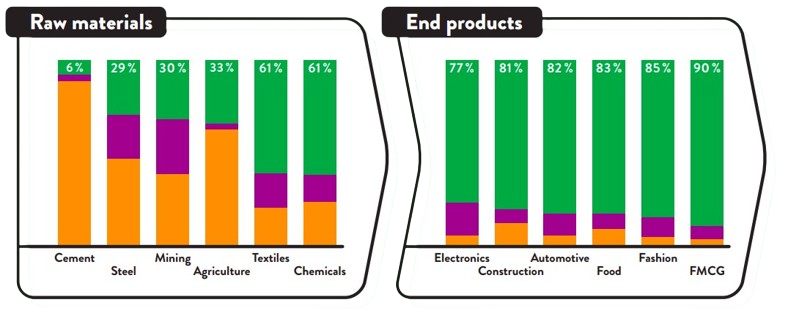
Note: Top companies selected based on number of reported
Scope 3 upstream categories and industry fit;
FMCG = fast-moving consumer goods
Source: CDP, BCG
Thus, procurement through its sustainability mandate has to challenge the status quo. This involves cross-functional teamwork with other departments, for example to identify eco-design or redesign opportunities, implying raw material sourcing changes, substitutes, and lower consumption. It is extremely important to work in partnership with suppliers on this issue. This sometimes requires a signifcant change in supplier relationship management as sustainability requires new governance.
Procurement must be able to address its suppliers with the appropriate resources proportionate to their impact on Scope 3 emissions and their role in the company’s procurement activities. New procedures are appearing where suppliers are expected to comply with requirements set by certification providers, to agree to audits and openly share data on a regular basis. Open discussion with key partners can help enormously in pushing ahead with measures and co-defining targets together. Wherever possible, suppliers need to understand the benefits of the actions themselves.
If they can see a benefit in the change for themselves, they will be more willing to buy into the initiative and not just see the issue as an annoying obligation in order to comply with their customer’s code of conduct. Price arguments are also always helpful here. For example, a supplier will be more inclined to commit to an objective of using green energy if, in return, a review of requirements allows for a simplification of the product, and thus a simplification of its production by the supplier. Procurement can steer their partners towards initiatives via supplier development activities, such as energy generation by installing solar panels as an alternative to purchasing electricity. The investment needed can be covered by low-interest ESG loans.
However hard a company tries, without procurement it won’t be able to significantly reduce its emissions.
For banks and funds, sustainable financing is a fast-growing, attractive business segment. In the first three quarters of last year, the share of sustainable funds increased to 44 percent, according to Commerzbank research. Investors now show a wide range of ESG preferences. Credit institutions are therefore working flat out to reduce the carbon footprint of their portfolios. Sustainability Linked Loans (SLL) are becoming more commonplace. With these, the interest rate is linked to a company‘s general sustainability goals and the achievement of certain key figures. This is intended to put a stop to greenwashing.
Since the majority of emissions are procured via the supply chain, this must not be ignored in the analysis. It is partly responsible for dubious business practices, violations of the law, environmental sins or unfair treatment of employees on the supplier side. To meet this responsibility, the entire supply chain, including the use of sustainable raw materials, product design, production, distribution channel, as well as disposal and recycling, must be considered and evaluated. One example is the procurement of chemical feedstocks. The EU wants to phase out a number of critical chemicals. However, the conversion process of chemical raw materials takes months to several years. This challenge can only be met through close, cross-functional cooperation between procurement, research & development, sales and quality management.

Internally, the key is to involve the whole organization. To do this, KPIs need to be incorporated into the procurement strategy. Established and shared companywide KPIs can include energy consumption, waste generation, or the recycling quota for manufactured products and raw materials. In this way, companies can ensure that sustainability doesn’t recede into the background as soon as the global situation takes a slight downturn. The more firmly sustainability is anchored in a company’s structures, the sooner these targets will be achieved.
As effective as the top-down approach is for implementing a sustainability strategy, without the commitment of the employees, this will not lead to success. Procurement managers are responsible for drawing up and kick-starting the strategy, but they can only implement it effectively with the help of their staff. Getting them on board and keeping them motivated is an important mission that will determine either success or failure.
Teams need to know what the company defines as sustainable and understand the value of the impact of their individual contributions. Achieving sustainability targets should also be linked to bonuses: a system that already works well for other KPIs.
There is still work to be done in many companies, with 41 % of study participants indicating that there is still potential for improvement when it comes to sustainability incentives. As for every change, teams must be guided with appropriate learning on the topic of sustainability and developing the required skillset so that they can take on the challenge.
These changes come at a cost but the resulting benefits are much larger, as companies focusing on sustainable procurement become more attractive for employees, talent acquisition, investors and customers.

The issue of sustainability needs to remain at the top of the agenda during the difficult times we are currently facing. Unfortunately though, even in 2022, many companies are still shying away from the enormity of the task, but this fear is not justified. Companies that divide their sustainability strategy into sub-projects with clear interim targets will see that transformation is possible. Developing the relevant skills may take some time, but with external help and clear incentive systems, sustainability will ideally soon become just as much a part of a company’s DNA as cost efficiency. To conclude, prioritizing sustainability is an essential part of a company’s future. Regulators, customers and staff are increasingly expecting companies to take the issue of sustainability seriously. Businesses that act quickly, transparently and credibly in this respect will be able to stand apart from the competition, because only genuinely sustainable companies will be able to remain competitive in the future.