It should be clear to everyone by now that the pressure to act on this issue is huge and will no longer go away.


// Preview | Table of contents & text extract
This issue of Supply Management Insights explores how companies can actively drive sustainable procurement – and why now is the time to act. It offers concrete approaches to turn sustainability ambitions into measurable impact across supply chains, complemented by expert insights and real-world examples. A must-read for anyone looking to turn sustainability from a buzzword into real business value.
Dear Readers,
The call for global climate protection measures is growing louder – to save our planet, but also to secure competitiveness. The good news is that companies want to live up to their responsibilities, as our latest sustainability study shows. Over 90 % of respondents already have a sustainability strategy. However, there is still a lack of actual implementation.
With our cover story, we want to shed light on this and support companies by showing them possible approaches. We have also spoken to renowned experts and present their ideas to you. When it comes to the procurement of raw materials in particular, many companies are faced with a dilemma. The energy turnaround can only be achieved by using considerable resources, but some of these are obtained under less than sustainable conditions. We show how raw material procurement can be organized on the basis of sustainability criteria.
In order to support you even better on your way to Sustainable Procurement, we have further strengthened our team in 2022.
It should be clear to everyone by now that the pressure to act on this issue is huge and will no longer go away.

Time to act

When it comes to the procurement of raw materials in particular, many companies are faced with a dilemma. We show how raw material procurement can be organized on the basis of sustainability criteria.

Interview with Cordula Richter, Global Organizational Change Lead at Quantis
If a company-wide sustainability strategy is to be successful, the issue has to be firmly anchored at the highest level. It also needs people to be responsible for driving its implementation. A Chief Sustainability Offer could be appointed specifically for this purpose, for example, or it could also be assigned to another area of executive management.
As well as this internal organization and defining of objectives, it is also of utmost importance to look outside the company. This means that managers need to consider their customers’ wishes in detail. Just meeting targets set by the regulatory authorities, to reduce CO2 for example, may not be enough. According to our study, legal requirements remain the most important driver of sustainable measures today. If your customers have higher standards (and they often do now), it is essential that this is reflected in your sustainability strategy. As a result of this, your own business model needs to have much more ambitious targets.
It is therefore important to set interim targets: milestones that need to be achieved in two, four or ten years. This will make the change seem more manageable, and high expectations will not immediately dampen enthusiasm for the subject. These interim targets do, however, need to cover the full impact of your company from the outset. This means that emissions throughout the supply chain need to be included.
However hard a company tries, without procurement it won’t be able to significantly reduce its emissions.

Interview with Manish Bhasin, Global Head of Sustainable Procurement at A.P. Moller Maersk

In this interview, the CPO of Bayer talks to us about changes in procurement, how a Life Science company with core competencies in the areas of healthcare and agriculture can become sustainable.

In this interview, Dirk Gratzel talks about the dilemma of economic success through wear and tear on the environment – and where managers should start withsustainable transformation.
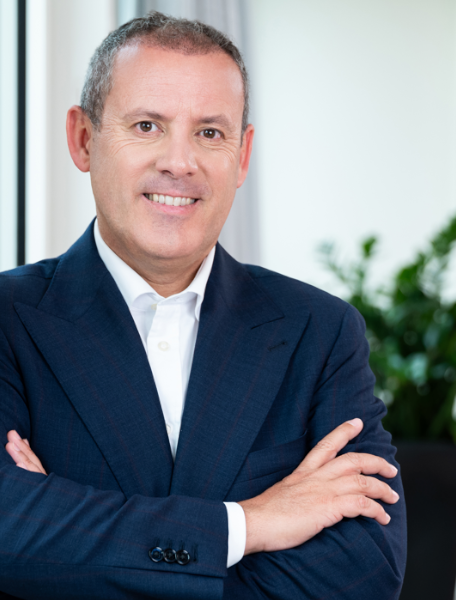
Get to know our new Managing Directors Giovanni Grillo in Milan in our People@Inverto series.

Alongside expanding into new locations, we continue to strengthen our existing markets. Jürgen Wetzstein, who recently joined our Munich team, shares his key priorities.