
Procurement leaders in industrial goods (IG) know the pain points all too well: volatile raw material prices cutting into margins, endless approval loops blocking efficiency, supply chain surprises disrupting production, and blind spots in reporting that erode trust. These challenges drain resources and keep procurement in firefighting mode – unless digitalization, AI and agentic AI are used to turn them into competitive advantage.
Best-in-class companies are showing that procurement digitalization, enhanced by AI, achieves more than cost reduction. It enables efficiency gains of around 20 percent, delivers sustainable savings of 2–5 percent, and creates resilience and foresight that put procurement into the driver’s seat.
At Inverto, we see digitalization and AI as enablers of measurable value – not as ends in themselves. In our projects, we distinguish between Efficiency Increase, which optimizes existing processes, and Value Delivery, which translates digital potential into tangible financial results. This ensures that digital initiatives create real competitive advantage instead of chasing technology for its own sake.
A Glimpse of the Future
Before looking at frameworks and roadmaps, it is worth pausing to consider the ambition. The future of procurement in industrial goods is not just about better reporting or one-off efficiency gains. It is about an ecosystem oflive data, full traceability, and zero surprises, where decision-makers gain foresight instead of reacting to crises.
The future of digital procurement combines live data, full traceability, and zero surprises – enabling industrial goods leaders to move from firefighting to foresight.
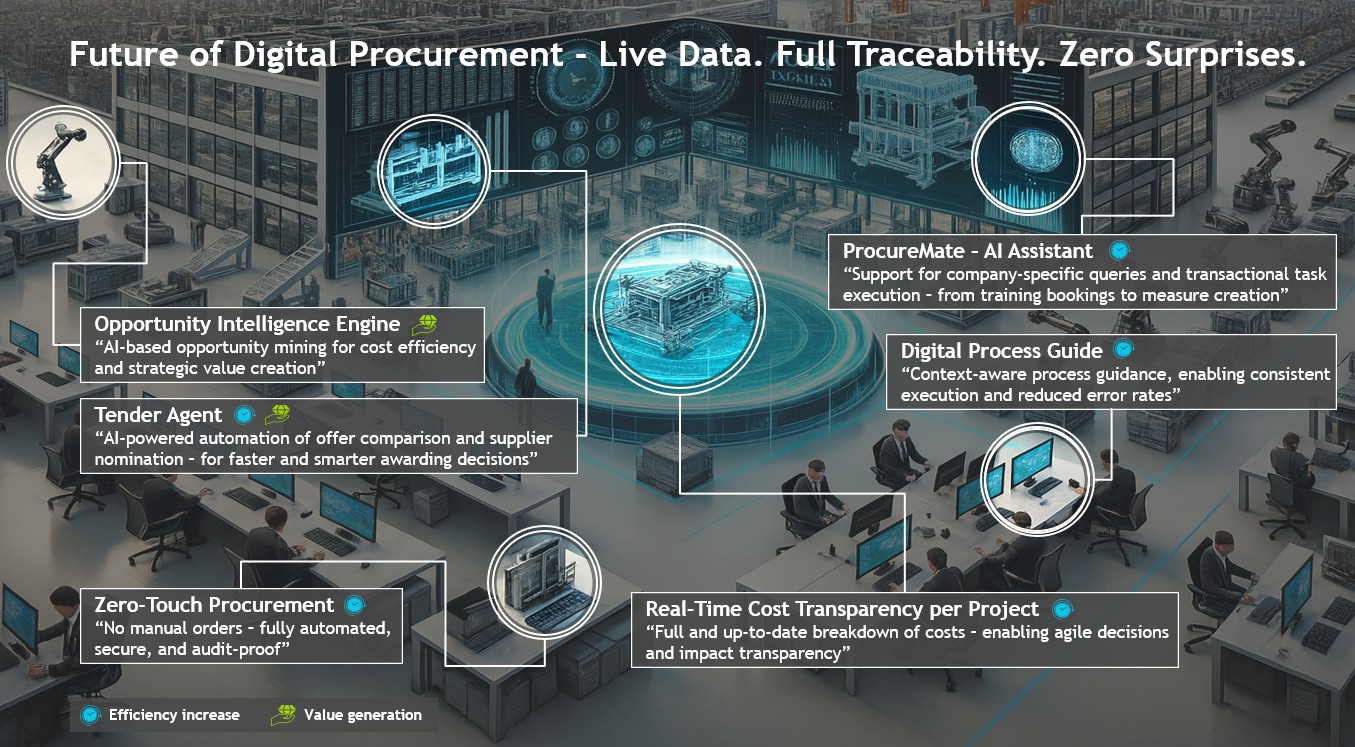
This vision may sound ambitious, but in practice, many elements are already being implemented: AI-based opportunity mining, zero-touch ordering, and real-time cost transparency.
Greatest Pain Points for IG Companies – and How Digitalization Addresses Them
Turning vision into practice is what makes the difference. At Inverto, we don’t just talk about procurement digitalization – we have implemented it across the entire procurement process: from spend analysis, supplier scouting, and tendering, all the way to contract management, P2P workflows, and payment processing. Over the course of numerous projects, we have built a portfolio of more than 30 proven digital and AI-enabled solutions, ensuring that every stage of the procurement lifecycle can be optimized and digitalized. This breadth of experience allows us to address the recurring pain points that industrial goods companies face – not with only concepts, but also with solutions that deliver measurable impact.
Raw material and energy volatility remains one of the biggest headaches for Chief Financial Officers (CFOs). Tracking price curves alone is rarely enough to protect profitability, and fragmented sourcing decisions across the organization often waste bundling potential.
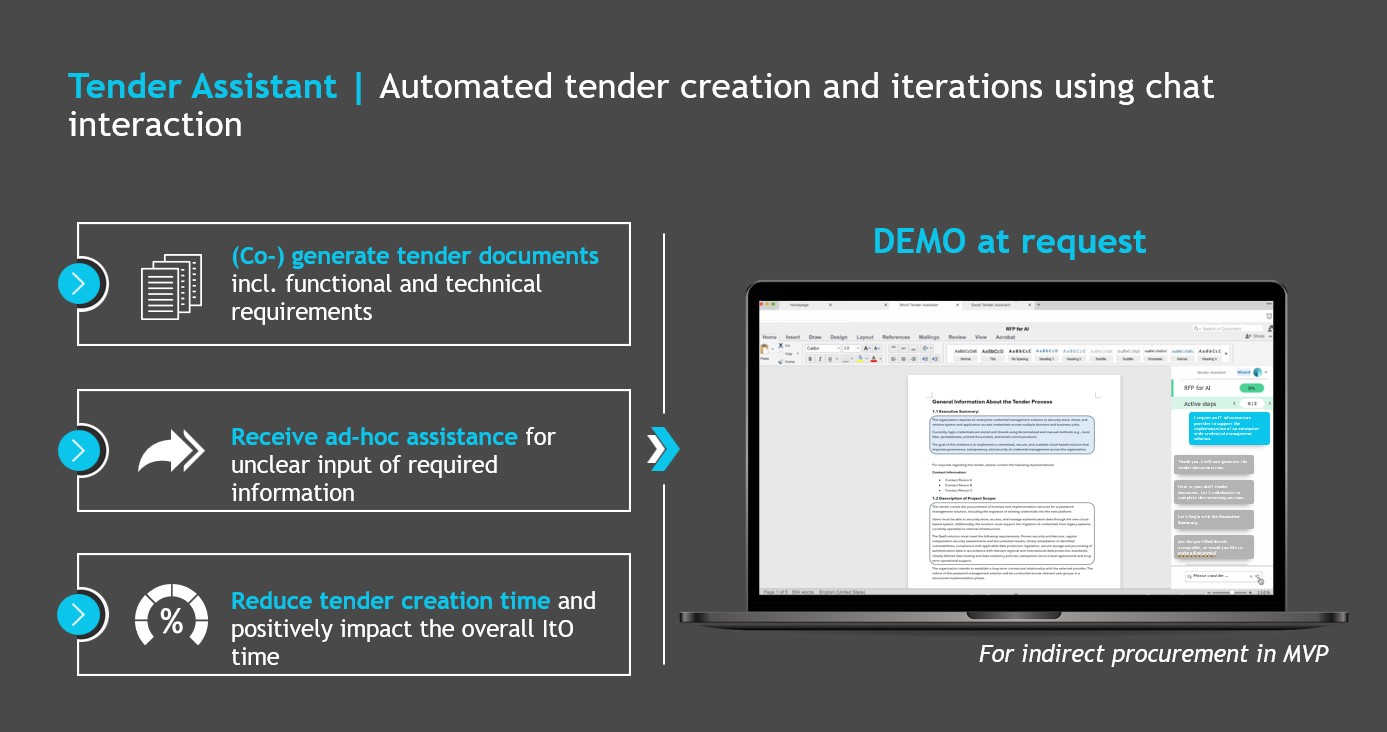
To address this, leading organizations use AI-based Tender Assistants that automatically compare offers, identify the optimal award scenario, and support faster, data-driven supplier nominations. This reduces manual effort, improves transparency, and ensures consistent awarding decisions. The Tender Assistant is embedded within the Agentic Procurement Hub – a single platform integrating all procurement knowledge, solutions, and AI agents, and accessible via the Agentic Procurement Gateway as a chat-based interface across the procurement process.
At an automotive original equipment manufacturer (OEM), applying the Tender Assistant streamlined the tendering process and enabled bundled negotiations, resulting in faster decisions and higher value capture.
Beyond strategic sourcing events, the AI-powered Claim Defender supports procurement teams in day-to-day business by enabling fact-based evaluation and systematic defense of supplier price increase claims. As an end-to-end solution, it guides buyers step by step through the tactical reaction and validation of cost drivers – helping to challenge and mitigate incoming claims, particularly in volatile situations such as geopolitical disruptions (e.g., Middle East conflict).
From Manual Effort to Intelligent Tendering
In many IG firms, endless approval loops and manual workflows are a constant frustration for Chief Procurement Officers (CPOs). They delay decisions, choke scalability, and consume resources that should be invested in value creation.
By redesigning and automating one-time payment processes, companies have cut cycle times by up to 75 percent and achieved productivity gains of more than 70 percent. These results are, for example, based on a previous transformation project at a leading premium automotive manufacturer in Southern Germany, where approval workflows were fundamentally redesigned and digitized.
Payment Process Optimization
Redesigning approval workflows can significantly reduce manual effort and cut system complexity.
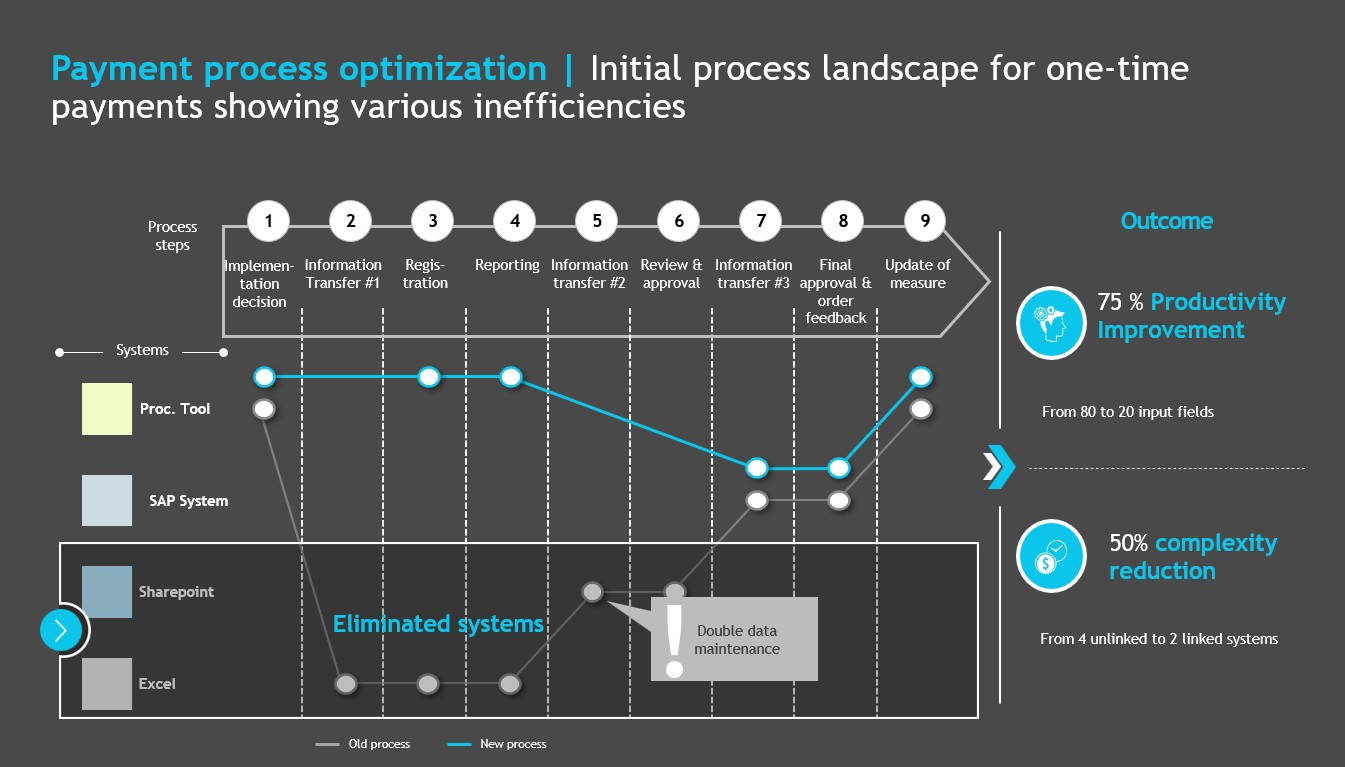
For the CFO, this means less leakage and tighter control. For the Chief Procurement Office (CPO), it means freed-up capacity to focus on strategic initiatives like supplier development, sustainability, or innovation partnerships.
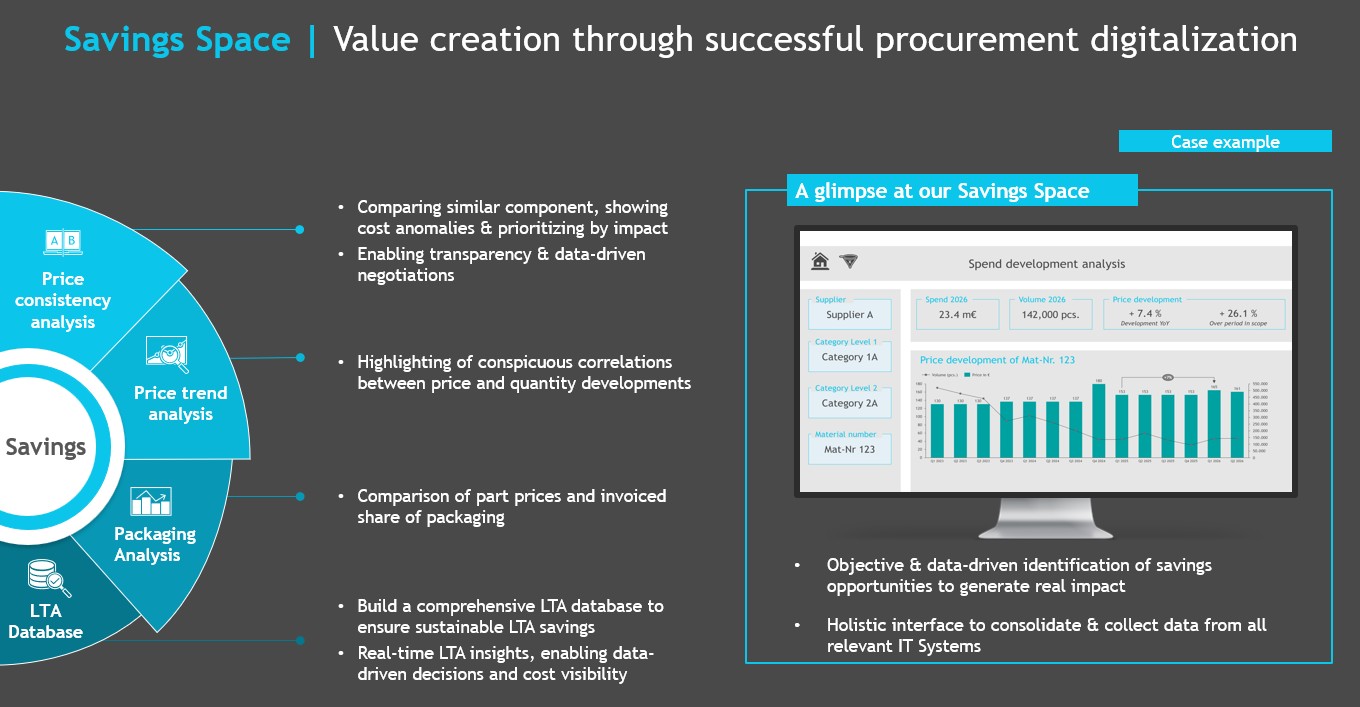
One of the most persistent pain points for procurement leaders is the gap between negotiated savings and realized savings. Even after successful negotiations, many cost reductions remain purely theoretical because there is no transparent way to track and enforce them. Without visibility, suppliers benefit from inaction, and companies lose the value they have already secured at the negotiation table.
To close this gap, leading organizations implement a central Long-Term Agreement (LTA) Database that captures, monitors, and enforces agreed cost reductions across all suppliers and business units. By leveraging AI, this digital backbone provides full transparency on contractual conditions, price developments, and saving realization status – transforming savings from ambition into measurable results.
 At another OEM, the LTA Database for instance ensured that negotiated savings were not only documented but continuously monitored and reflected in procurement reporting. The result: sustainable cost reductions and significantly improved alignment between procurement, controlling, and management.
A Strategic Framework for Scaling Digital Procurement: The Digital Navigator
Ambition and examples are important, but many leaders ask: where do we begin? This is where a structured framework makes the difference.
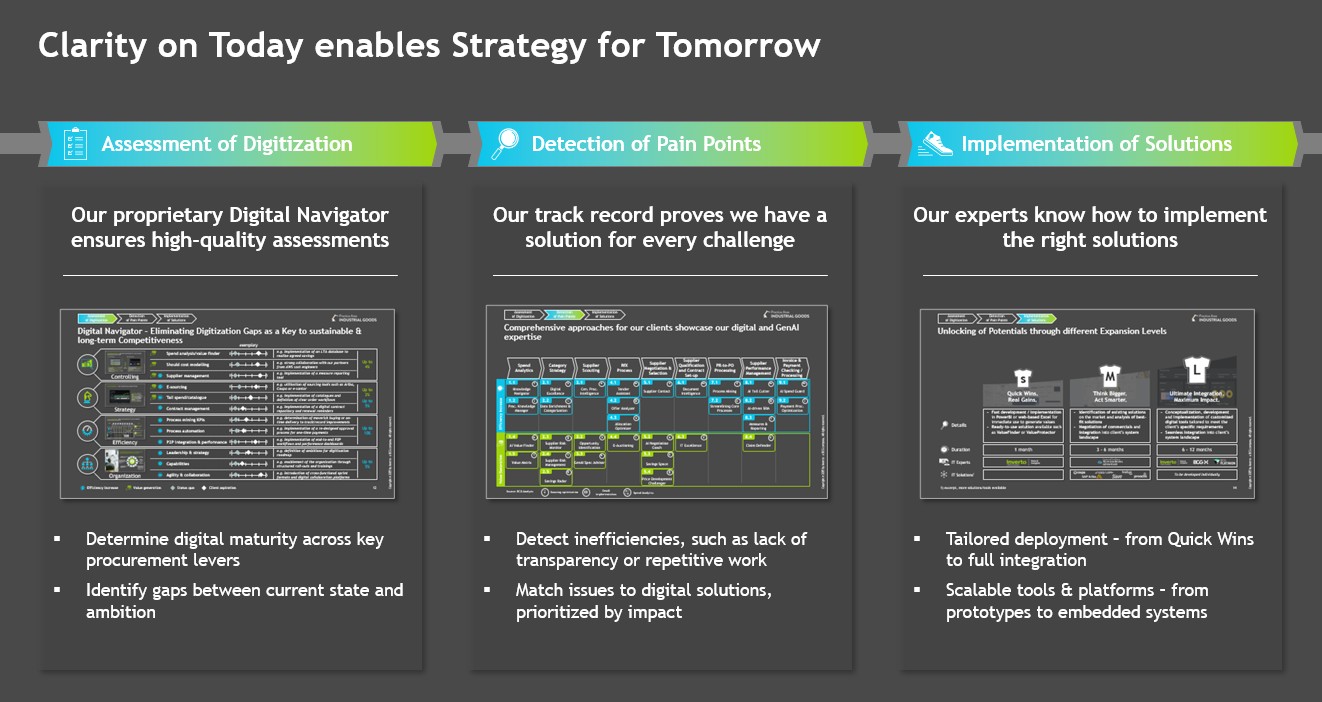
// The Digital Navigator helps companies assess maturity, detect pain points, and implement scalable solutions – from quick wins to full integration.
By starting with a maturity assessment, identifying inefficiencies, and prioritizing initiatives by impact, companies avoid fragmented efforts. The framework ensures digitalization is not a collection of tools but a coherent journey toward resilience and competitiveness.


// Conclusion
From Efficiency to Foresight
The industrial goods sector has reached an inflection point. Procurement digitalization is no longer a question of if, but of how quickly and how strategically. Companies that take a best-in-class approach will not only reduce costs and increase efficiency; they will create the foresight and resilience needed to thrive in an uncertain market.
For CFOs, CEOs, and CPOs, the message is clear: procurement digitalization is not just about tools – it is about measurable results and long-term competitiveness.
Get in Touch

Lars-Peter Häfele
Managing Director
Munich

Gök Robold
Managing Director
Munich

Sebastian Rudolph
Principal
Munich