Only 34 % of the companies felt well prepared for the enforcement of the Supply Chain Act.


// SMI 12 | Nearshoring – Reshaping Supply Chains
Good intentions aren’t enough anymore: The Supply Chain Act (LkSG) has made voluntary commitments to environmental protection and human rights in Germany a legal requirement. What are companies doing about this? And what more do they need to do to comply with the legislation?
Only around a third of those surveyed as part of the Inverto Risk Management Study said they were well prepared for the new legislation – this is a rather concerning statistic given that the new legislation came into force only eight to ten weeks’ later.
The risk analysis guidance from the Federal Office of Economics and Export Control (BAFA) was only published in August 2022, when many companies had already begun their supply chain analyses. The rules on what annual reports should look like in the future and information on adequacy, effectiveness, and complaints procedures were only published in October. In terms of content, all those we interviewed complained that the information was not entirely clear and precise.
“We started the process at the end of 2021, when it was still not clear what BAFA wanted. We were trying to hit a moving target, so it was a challenge,” said a procurement manager from a media company. And a head of procurement at a software firm was also critical: “Unfortunately, the legislation leaves so much room for interpretation that I don’t know which resources to use to implement the Supply Chain Act and be compliant with it. There’s a great deal of room for interpretation.” “We have the feeling that there are still ambiguities on the legislative side as well,” said a procurement manager at a global energy technology manufacturer, summing up his skepticism.
// Name the biggest challenges in your organization in the course of implementing the German Supply Chain Act (LkSG)? (Multiple selection possible)
Time effort
Limited ability to influence suppliers
Lack of expertise
Creation of transparency in own business unit and at suppliers
According to our research, at the time of conducting the survey around two thirds of those surveyed had analyzed the risks to human rights and the environment in their own business area and adopted the policy statement required by law. Approximately 60 % had integrated the Supply Chain Act into their risk management strategy and developed compliant procurement and product strategies. Around half had begun to train up their employees.
“Especially at the beginning, we took a significant amount of time to educate our people about the topic, including the management team. What is sustainability? Why sustainability? It always sounds so straightforward, but the process alone has taken a lot of time,” recalls the sustainability manager at an IT firm. Procurement is, of course, especially important, but the other departments also need to develop skills: “Ultimately, it’s the departments that think about how we implement it,” said the procurement manager at the same energy technology manufacturer quoted above.
The respondents saw the significant amount of time required as the greatest challenge (77 %). 57 % stated they only had a limited influence on their suppliers, while 45 % put the problem down to a lack of expertise and insufficient transparency.
// What actions have already been taken for the German Supply Chain Act (LkSG)? In which stage of development are you currently located for each action? (Multiple selection possible )
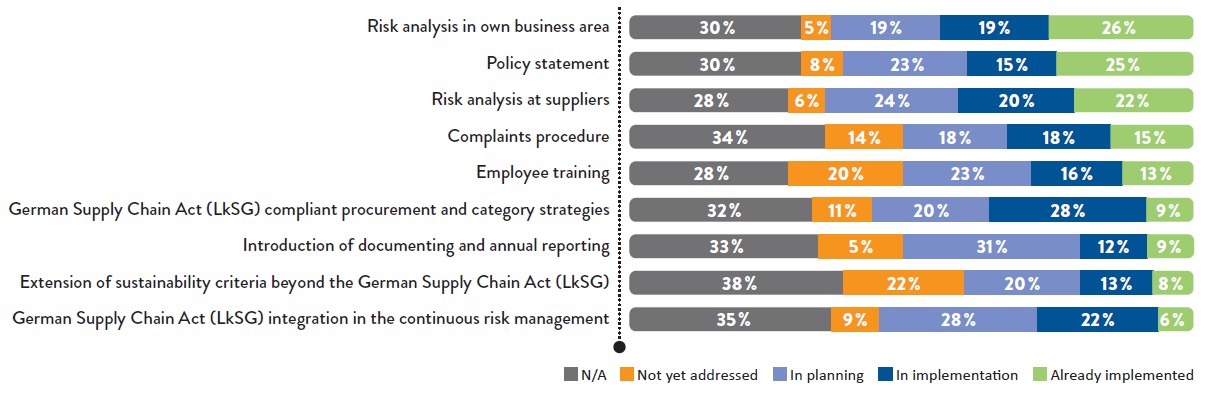
Only 34 % of the companies felt well prepared for the enforcement of the Supply Chain Act.
Managers are hopeful that digital tools will provide the solutions they need. Virtually all those who took part in the in-depth interviews described working with software to examine their complex supply networks and process the enormous quantities of data. Companies tend to use software from specialist sustainability and/or risk management providers.
“You can’t master the complexity without a digital tool to help you. That means that somewhere you need a data logger that records and compresses all the information. It has to be consolidated in such a way that I know where to look if there’s ever cause for suspicion,” explained a procurement manager and sustainability expert at an electrical equipment manufacturer. A procurement manager at a software corporation emphasized the importance of functioning interfaces: “A very simple communication platform needs to be set up, because suppliers will be asked questions about this by thousands of customers. At the same time, they must be able to provide all the information, including certificates. All of this needs to be brought together nicely and neatly on a communications platform to make the relevant information available end-to-end through these network effects.”
You can’t master the complexity without a digital tool to help you.
Companies that made few if any sustainability efforts prior to the Supply Chain Act being adopted, saw themselves at a clear disadvantage compared to those who adopted their initial strategy a few years ago. “Environmental and human rights standards are core components of the requirements placed on our suppliers. We have always published these in the Code of Conduct for Business Partners. We have added the topics now embedded within the Supply Chain Act that we hadn’t covered previously. However, environmental and human rights standards have long been requirements in principle. We have been auditing suppliers on these for the last ten years,” explains the procurement and supply chain manager at an automotive and electronics group.
On the other hand, the legislation has been an eyeopener in many companies, forcing some of them to redefine the concept of risk: “The Supply Chain Act requires you to change your perspective you have to look at what risks we face. For the first time, we had to really understand what our supply chains look like,” explained a sustainability manager who works in the IT sector. For others, the legislation has created a need to do more than the absolute minimum, according to a process manager at an engineering company: “Our first priority is naturally to fulfil the minimum requirements. As soon as these are embedded within the company and have become part of the routine, we then want to increase transparency in the supply chain and influence the entire supply chain, i.e. steer and monitor our suppliers accordingly.”
The Supply Chain Act requires you to change your perspective – you have to look at what risks we face. For the first time, we had to really understand what our supply chains look like.


Even companies that are not covered by the legislation or only indirectly – as suppliers to larger customers – should make sure they are fully au fait with the Supply Chain Act regulations and examine their supply chains. After all, companies must create a clear operational framework for their employees to meet the demands of everyday business, especially if many provisions are not very clear. There is little point in waiting, as the European Union is planning the extension of the law; the Legal Committee approved the draft at the end of April. This law will then replace all national regulations throughout the EU, including the Supply Chain Act. Companies that are now training their employees, building knowledge, choosing the right monitoring tools, and consulting with their suppliers will clearly have the upper hand.
Stefan Benett
Managing Director
Munich

Gök Robold
Managing Director
Munich