5–12% cost reduction is achievable when technical and commercial levers are addressed together

The Bill of Materials (BOM) has evolved from an engineering document into a strategic profit lever. It is rapidly becoming a CEO-level priority amid cost volatility and margin pressure. Companies that go beyond traditional negotiations and actively manage the BOM can unlock substantial, sustainable value.
- 5–12% cost reduction achievable through combined technical and commercial levers, far beyond traditional sourcing approaches
- Over 50% of savings potential sits in design, process, and supplier economics, not in price negotiations alone
- BOM approaches enable end-to-end value capture: from Tier-2 optimization to OEM price retention
- AI enabled workflows have redefined cost engineering, turning BOM management into a fully scalable value lever – challenging cost transparency and models on a supplier level
From Price Management to Cost Engineering
For years, cost optimization followed a clear logic: negotiate harder, benchmark suppliers, and adjust prices. That approach is now reaching its limits.
Margins remain under pressure from volatile input costs, increasing product complexity, and fragmented supply chains. At the same time, procurement organizations have largely exhausted traditional levers. The biggest untapped lever sits elsewhere: in the Bill of Materials.
Increasingly, advanced analytics and AI are enabling companies to understand and reshape this cost structure with a level of precision that was not possible before.
The BOM is more than a technical document. It defines how cost is built up: across design, materials, and supplier processes. Yet in most organizations, it is not actively managed as a profit driver.
This creates a structural gap: engineering optimizes performance, procurement negotiates prices, and finance monitors outcomes.
But no function owns cost end-to-end.
The consequence is significant. In many cases, more than half of the cost-saving potential remains outside traditional negotiations, embedded in design choices, specifications, and supplier economics.
Leading companies are closing this gap. They shift from price management to cost engineering -systematically shaping the BOM, understanding supplier cost structures, and ensuring that savings translate into real margin impact.
The Real Value sits in 3 Areas
Most cost programs still focus on negotiations. While necessary, this approach addresses only part of the opportunity. A significant share of product cost is already defined before sourcing begins – embedded in the Bill of Materials and the underlying design and supply chain setup.
In practice, the largest value pools are concentrated in three areas:
-
Design-driven cost
- Overengineering and overly tight specifications
- Limited part commonality across platforms
- Material choices not optimized for cost-performance
-
Supplier economics
- Inefficient production setups beyond Tier-1
- Missing scale effects and suboptimal volume allocation
- Limited transparency on actual cost structures
-
Commercial setup
- Weak fact base in negotiations
- Savings passed through instead of retained
- Unstructured handling of changes and investments
For CPOs and CFOs, the implication is clear: these levers sit across functions and cannot be captured in isolation. Engineering decisions, supplier cost structures, and commercial outcomes are tightly interconnected, yet rarely managed as such.
As a result, cost is often optimized locally but not end-to-end. Leading organizations address this by linking design, procurement, and finance into a single cost logic. They ensure that opportunities are not only identified, but also realized and retained in the P&L.

The Engine behind BOM Attack
At the core of a successful BOM Attack lies the ability to combine two perspectives: understanding how cost is created, and systematically identifying how it can be reduced.
Leading organizations are increasingly using integrated toolsets that bring these perspectives together.
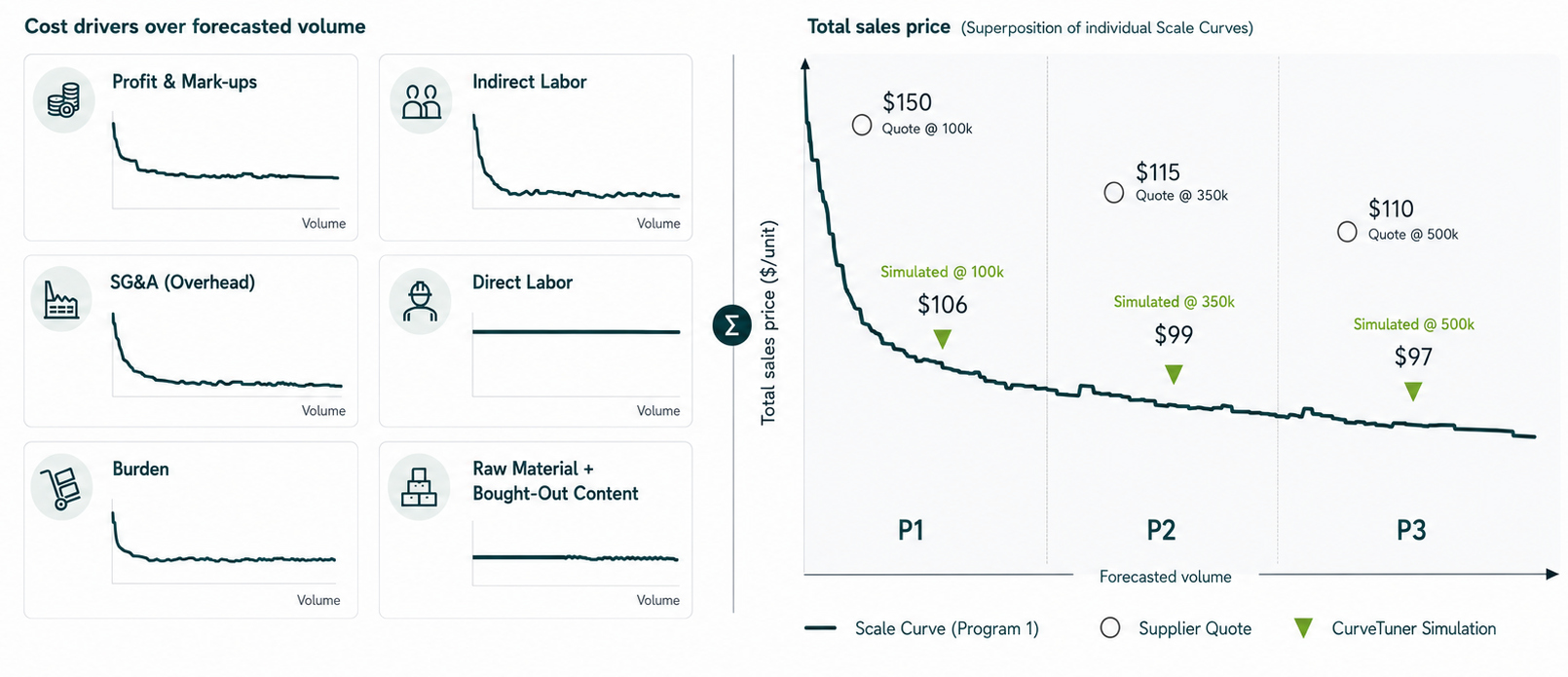
Inverto’s CurveTuner for example provides full transparency on supplier economics. It models the real cost curve of a component based on process steps, cycle times, labor, machine utilization, and volume effects. The result is an objective baseline tailored to specific production setups and design choices – enabling fact-based discussions with both engineers and suppliers.
Curve Tuner
Reveals true supplier economics, benefits of scale
Example for similar products on two different programs – showcase of scale & bundeling benefits
Techlever.AI
Complementing this, Techlever.AI – Inverto’s AI-powered value engineering tool – accelerates the identification of technical levers. Using GenAI trained on category data and proven value-engineering approaches, it analyzes specifications or CAD inputs and suggests concrete improvements. They may range from geometry simplifications to alternative materials and standardization options.
The combination is critical:
CurveTuner quantifies what is achievable, while Techlever.AI reveals how to achieve it.
In practice, this fundamentally changes how teams work. Instead of starting from scratch, they operate with a structured pipeline of quantified opportunities – aligned across engineering, procurement, and suppliers from the outset.
In one example, aligning volumes across programs and optimizing design parameters reduced unit cost by more than 30% compared to initial quotes. This was driven primarily by scale effects and process efficiency, not negotiation.

From Approach to Execution
The next wave of competitiveness will not come from pushing suppliers harder, it will come from understanding cost better.
For CPOs and CFOs, this means taking joint ownership of the Bill of Materials as a core value driver. It requires moving beyond price discussions to actively shaping cost structures: linking design, supplier economics, and commercial strategy into one integrated approach.
Those who succeed will not only unlock savings. They will build a structural advantage -embedding cost engineering as a capability that continuously improves margin, resilience, and competitiveness.
Our Experts

Paul Zahn
Managing Director
Chicago

Andrew Loh
Managing Director & Senior Partner BCG
Atlanta

Moritz Hagemann
Project Manager
Chicago

Stanley Keller
Senior Project Manager
Chicago
Further Insights