Strategic Procurement in Telecommunications
Procurement has become one of the most powerful levers for value creation in the telecommunications industry. With external spend often accounting for around half of a telco’s revenue, even modest improvements in how third-party costs are managed can have a material impact on financial performance.
At the same time, telecom operators face structural cost pressure, increasing technology complexity, and high dependency on strategic suppliers. In this environment, traditional procurement approaches are no longer sufficient.
What is changing is not only the scale of procurement’s impact, but its role: leading operators are moving procurement upstream – from a downstream cost function to an enterprise capability that shapes demand, technical choices, and supplier models.


Video
Insights from MWC Barcelona
A Practical Perspective on Procurement Transformation
Across telecom operators, successful procurement transformations share several common characteristics. One of the most consistent patterns is where value actually materializes.
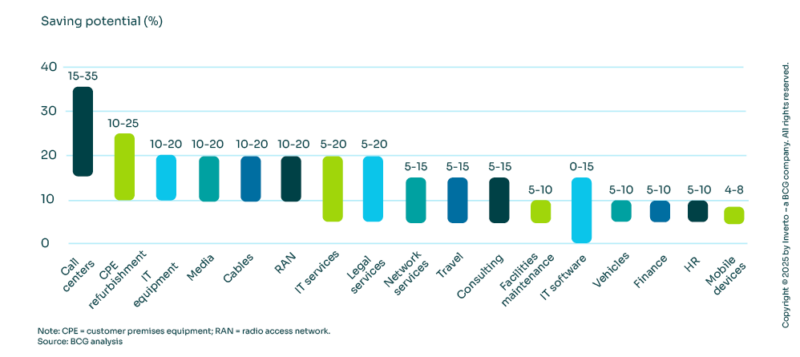
In practice, procurement impact in telecom concentrates in a limited number of spend categories – particularly where scale, complexity, and operating models intersect.
Based on our experience, focusing early on these categories helps generate faster and more tangible results and builds momentum for broader transformation efforts.
The graphic below illustrates where this impact most often materializes.
// Where Telecom Operators Often Unlock the Fastest Procurement Impact
-
These categories tend to offer stronger near-term impact because they combine high external spend with opportunities to challenge demand, specifications, delivery models, and supplier productivity. The specific potential varies by operator, maturity, and scope.
Beyond category focus, successful transformations are typically characterized by the following elements:
-

Upstream Focus on Demand and Specifications
A large share of value sits in how services are defined and consumed. Leading operators systematically challenge demand, reduce over-specification, and standardize requirements across network, IT, and service categories.
-

Integration of GenAI into Procurement
GenAI is increasingly used to enhance analytics, accelerate negotiations, and improve operational efficiency — both within procurement teams and at suppliers. The focus is on capturing productivity gains in a measurable and sustainable way.
-

Supplier Collaboration in Concentrated Markets
Given high supplier dependency in telecoms, value creation often depends more on collaboration and transparency than on frequent supplier switching.
-

End-to-End Governance and Accountability
To ensure savings translate into P&L impact, procurement transformations require clear ownership, cross-functional governance, and disciplined performance tracking.

Related Thought Leadership
This insight connects to themes explored in BCG and Inverto’s latest co-publication, “How Telcos Win with Strategic Procurement”.
The full publication explores in more depth:
- Why procurement can deliver faster and more material impact than other transformation levers
- How leading telecom operators unlock value beyond price negotiations
- Where GenAI is already changing procurement productivity
- Which spend categories offer the largest near-term potential
- How procurement operating models and governance need to evolve to ensure P&L impact
In addition, the latest TeBIT 2025 benchmark by BCG and ETIS provides a broader industry view on the performance pressures facing telecom operators and the growing importance of AI-driven efficiency and adjacencies.
The study highlights:
- Continued revenue and margin stagnation across European telcos
- The increasing shift from CAPEX to OPEX structures
- AI and GenAI as dual levers for productivity and growth
- The need for targeted operating-model adjustments to capture impact at scale
Get in Touch

Further Insights